How an Aurora Night in Tromsø Actually Runs
Nothing on a booking page prepares you for how much of an aurora chase is spent in a vehicle. Here is the shape of the evening, drawn from what the five listings state and what their reviewers describe.
The forecast decides the route, and it decides it late
Every operator here says a version of the same thing: the route is chosen on the night. Arctic Breeze writes that its team evaluates weather forecasts and aurora activity to find viewing spots and is ready to go the extra mile, even to Finland or Sweden. Jeshua As sells its trip as a live mission built on satellite cloud movement and solar activity. Northern Horizon states it drives to Finland and Sweden if necessary.
What that means in practice is that your guide often does not know where you are going when you climb aboard. Cloud in Tromsø is the enemy, not a quiet sun — the aurora oval sits over the city for most of the winter, and on a typical night the question is whether there is a hole in the cloud within driving range. Reviewers on the Greenlander chase describe being driven more than two hours to the Finnish border through a snowstorm because that was where the sky was open.
So the first thing to accept is that a Tromsø aurora tour is a driving tour with stops, not a viewpoint with a shuttle.
Pickup is a hotel doorway, not a bus station
Four of the five gather at recognisable buildings in the centre. Arctic Breeze meets outside The Dock Hotel and tells you to look for orange jackets. Jeshua As meets in front of the Radisson Blu main entrance and asks you not to go inside or bother the staff. Greenlander uses the main entrance of Scandic Ishavshotel at Fredrik Langes gate 2. Chasing Lights meets at the Prostneset bus terminal on Samuel Arnesens gate 5, exiting through the main hall.
Only the Greenlander minivan includes hotel and port transfers in both directions. Chasing Lights collects you from your hotel and drops you in the city centre. Arctic Breeze drops off but does not pick up. Jeshua As does neither — its pickup is listed as an exclusion, which is part of why the seat costs $59.
If you are staying outside the centre, that difference is worth more than it looks at midnight in February.
The first hour is the briefing and the suit
The chase opens with a talk about the night's conditions. Arctic Breeze calls it an honest briefing, and reviewers repeatedly single out guides who explained their routing decisions out loud rather than driving in silence.
Then the clothing. On four of the five listings a thermal suit comes with the seat, worn over your own clothes; you keep it on for the outdoor stops and take it off in the vehicle. It is a working garment, not a fashion item, and it is the single piece of kit that decides how long you can stand still in the dark. On the $59 coach the suit is a rental you add at checkout, and the listing recommends reserving it in advance.
Boots matter almost as much. Northern Horizon hands out boots with the premium seat. Greenlander and Chasing Lights include them only if you submitted your size after booking. Nobody rents you socks.
Then you drive, and the drive is the tour
The stated durations are the giveaway. Arctic Breeze prints six hours and then says in the fine print that it varies from 5 to 8 hours. Northern Horizon prints seven and says 6 to 9. Greenlander sells 6 to 9. Chasing Lights sells 5 to 9 and puts eight hours in its itinerary.
Those ranges are not padding. They are the difference between the sky being clear over Kvaløya twenty minutes from town and being clear only across the Finnish border, two hours and change up the Skibotn valley. Two reviewers on separate tours describe crossing into Lapland on the same kind of night.
Between stops there is very little to do. Bring a downloaded playlist and eat before you go if the tour does not feed you properly — of the five, only Greenlander includes dinner and only Chasing Lights includes a warm meal. The others feed you hot chocolate, biscuits and, at Northern Horizon, reindeer sausages on a campfire.
The oval matters more than the number everyone quotes
Travellers arrive in Tromsø watching the KP index on an app, and guides spend a good part of the briefing gently dismantling that habit. KP is a planetary scale of geomagnetic disturbance; it tells you how far south the auroral oval has pushed. Tromsø is already under the oval at 69.6° north, which is the entire reason the industry exists here.
The practical consequence is that a KP of 2 is a perfectly good night in Tromsø and would be nothing at all in Oslo. Guides watch cloud cover, solar wind speed and the direction of the interplanetary magnetic field instead, on sites like SpaceWeatherLive, and they compare notes with each other across companies while they drive.
So when a listing says the route is decided live — as Jeshua As does when it sells satellite weather analysis, and as Arctic Breeze does when it says the main key is finding the best weather conditions — that is not marketing language. On most nights the aurora is up there and the argument is entirely about cloud. It also explains why a chase can drive two hours and still be the right call: it is not looking for a stronger sky, it is looking for a hole in the one it has.
The stop itself is shorter than you imagine
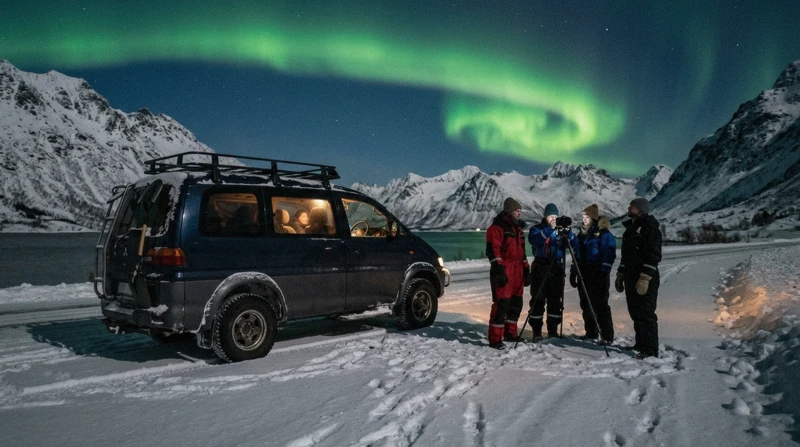
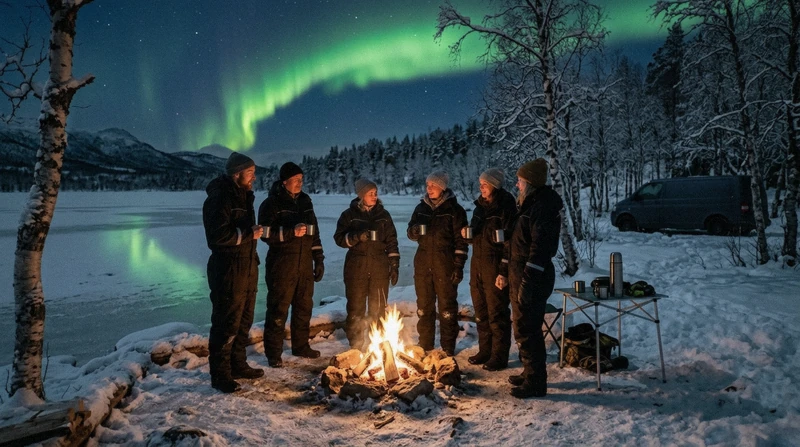
When a gap opens, the vehicle pulls over — often on a road shoulder, sometimes at a lake, occasionally at a prepared fire site. The guide sets up. Photographs get taken, of the sky and of you. Hot drinks come out.
A good display can run for an hour. A weak one can be over in ten minutes and send everyone back into the van to drive on to the next hole in the cloud. Several reviews on this page's listings describe exactly that pattern: three stops, two of them blank, one of them the reason they came.
The honest expectation to hold is the one Jeshua As prints on its own page — that photographs often depict the aurora stronger than the eye sees it. A camera collects light over several seconds; your eye does not. A faint band that photographs bright green frequently looks grey-white overhead. That is not a failed tour. That is the aurora on an average night.
 Tromsø Aurora Borealis Tours